Artificial intelligence is becoming an important part of how businesses create marketing materials, manage digital assets, and coordinate everyday operations. As organizations adopt generative AI, attention is increasingly shifting from individual content-generation tools toward systems that can support complete business workflows.
FancyAI Skills form part of this development. They are specialized artificial intelligence capabilities offered through the FancyAI platform, which focuses on connecting AI agents, creative models, business information, and professional workflows.
FancyAI positions its technology primarily for marketers, retailers, e-commerce businesses, and organizations seeking to incorporate AI into their existing operations. Its published platform materials describe applications involving customer relationship management, product launches, advertising content, digital asset management, and creative production.
Rather than operating exclusively as a conventional image or video generator, FancyAI presents a broader environment in which task-specific AI capabilities can work alongside enterprise systems and creative tools.
This article examines FancyAI Skills, their documented features, the AI models associated with the platform, their practical business applications, and the considerations organizations should assess before adopting them.
Table of Contents
What Are FancyAI Skills?
FancyAI Skills are specialized AI-powered capabilities designed to assist with particular professional tasks. They belong to the wider FancyAI platform, which combines generative artificial intelligence, specialized agents, and business workflow integrations.
The term skills refers to task-oriented functions rather than educational courses or professional qualifications. These functions are intended to help users perform activities such as preparing marketing campaigns, organizing creative assets, analyzing business information, and producing digital content.
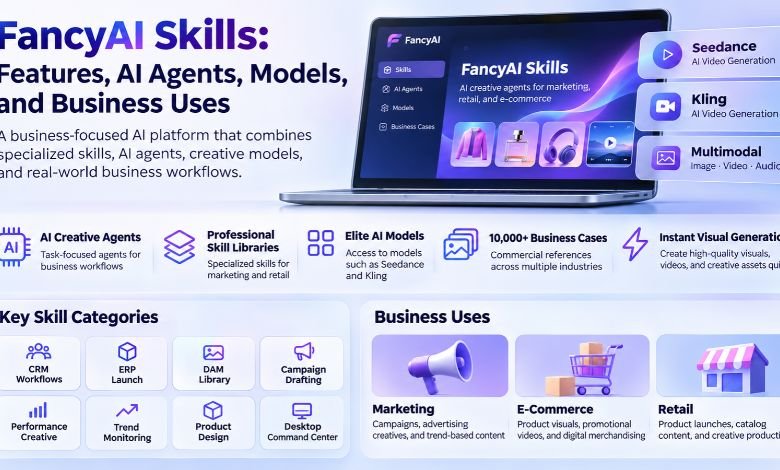
FancyAI’s published desktop documentation identifies eight principal skill categories: CRM Workflows, ERP Launch, DAM Library, Campaign Drafting, Performance Creative, Trend Monitoring, Product Design, and Desktop Command Center.
Each addresses a different operational requirement. Some focus on preparing content, while others concern business data, workflow coordination, or the management of existing materials.
The Purpose of FancyAI Skills
The principal purpose of FancyAI Skills is to connect artificial intelligence with established business processes.
Many generative AI applications produce outputs in response to individual prompts. Businesses may then need to transfer those outputs manually into other software, check them against internal information, and prepare them for publication.
FancyAI’s approach is intended to reduce these disconnected steps by allowing AI capabilities to operate within workflows involving existing company resources.
For example, a business might use product information from an enterprise resource planning system to prepare marketing materials or use approved creative assets when developing new advertising variations.
The usefulness of this approach depends on the quality of the underlying data, the integrations available, and the level of human oversight applied to generated results.
Who Can Use FancyAI Skills?
FancyAI identifies several professional audiences for its platform.
Marketing teams can use AI-assisted workflows to prepare campaign materials and explore creative concepts. E-commerce businesses can apply similar capabilities to product images, descriptions, and promotional content.
Retail organizations may find applications in product launches, catalog preparation, and digital merchandising. Creative teams can use specialized capabilities to develop visual concepts and manage approved brand materials.
The platform also targets organizations working with customer relationship management systems, enterprise resource planning software, and digital asset libraries.
Its suitability for individual users or large enterprises depends on their technical requirements, available integrations, and commercial access arrangements.
How Do FancyAI Skills Work?
FancyAI Skills operate within a platform that brings together specialized AI functions, business information, and content-generation capabilities.
The published product descriptions present skills as components of larger workflows rather than isolated applications.
A typical business process can involve supplying an instruction, accessing relevant information, generating an output, and reviewing the result before it is used.
The exact sequence varies according to the particular skill and the systems connected to the platform.
Specialized AI Agents and Task Execution
FancyAI promotes specialized AI agents, sometimes described in its marketing materials as AI employees or AI experts.
These agents are presented as software-based assistants capable of working on defined professional objectives.
An agent and a skill serve related but different purposes. An agent represents the software component responsible for handling a task or coordinating a workflow. A skill describes a particular capability available to that agent or the broader platform.
For example, an AI agent supporting marketing activities could use campaign drafting capabilities to prepare advertising concepts using information supplied by a business.
The level of autonomy available to individual agents should not be assumed to be identical across all tasks. Some activities may require additional configurations, permissions, integrations, or user approval.
Connecting FancyAI Skills With Business Systems
A significant part of FancyAI’s product positioning concerns integrations with existing software.
Its desktop documentation describes connections involving customer relationship management (CRM), enterprise resource planning (ERP), digital asset management (DAM), advertising platforms, and communication tools.
These systems perform different functions.
CRM software stores customer information and supports activities such as sales management and customer communication. ERP systems manage operational information, including products and inventory. DAM software organizes digital materials such as images, videos, and approved design assets.
By connecting relevant systems, AI workflows can use business information as context rather than relying exclusively on manually written prompts.
FancyAI lists several third-party services in its integration materials. However, the presence of a service in a published connector list does not independently establish that every integration is available under every account or subscription.
Also Read: BrumeBlog.com: Website Overview, Content Categories, Features, and Reader Guide
Key Features of FancyAI Skills
FancyAI’s documented skills cover several areas of business operations and creative production. The individual categories provide a more specific understanding of the platform than general claims about AI automation.
CRM Workflows
The CRM Workflows skill is designed to work with customer-related information.
According to FancyAI’s documentation, its intended applications include analyzing customer behavior, identifying possible customer retention issues, and preparing personalized re-engagement campaigns.
For a marketing department, this could involve using existing customer records to develop communication strategies for different customer groups.
Such workflows require careful attention to data quality, privacy obligations, and the accuracy of customer segmentation.
ERP Launch
ERP Launch connects product information with the preparation of marketing materials.
FancyAI describes workflows in which newly registered products can initiate the creation of visual assets, specification sheets, or other launch-related content.
This capability is relevant to retailers that regularly introduce new products.
The intended benefit is greater consistency between operational product records and the materials used for marketing. However, generated content still requires checks against the actual product specifications.
DAM Library
The DAM Library skill focuses on finding, organizing, and reusing digital assets.
A digital asset management system can contain approved photographs, illustrations, branding materials, videos, and campaign resources.
FancyAI describes its DAM capability as a way to make those materials accessible during AI-supported creative processes.
Using an established asset library can help teams maintain consistent visual references across different projects.
It does not, by itself, guarantee that every generated image or design will comply with a company’s brand guidelines.
Campaign Drafting
Campaign Drafting supports the preparation of marketing content.
FancyAI identifies campaign briefs, advertising concepts, landing page sections, and promotional copy variations among its applications.
This type of capability can assist during the early stages of campaign development, when teams evaluate alternative messages and creative directions.
Its practical value depends on how accurately the generated material reflects the intended audience, available products, and campaign objectives.
Performance Creative
Performance Creative is intended to support advertising teams that develop new content using information from existing campaigns.
FancyAI describes the capability as transforming successful advertising concepts and performance signals into additional creative variations.
The distinction between generating content and improving advertising results is important. AI can prepare alternative materials, but whether those alternatives perform better requires measurement through actual campaigns.
Trend Monitoring
Trend Monitoring concerns the analysis of social and market signals.
FancyAI presents this skill as a means of identifying emerging topics and preparing content informed by those developments.
Potential applications include social media planning, campaign research, and the preparation of timely marketing materials.
Trend information should be evaluated for relevance, accuracy, and audience suitability. Popularity alone does not establish that a topic is appropriate for a particular business.
Product Design
The Product Design skill addresses the development and refinement of product concepts.
FancyAI describes functions involving the analysis of commercially successful aesthetics, design patterns, and visual directions.
Businesses working in fashion, retail, and other design-oriented industries may use this type of capability during concept exploration.
Organizations must nevertheless assess originality, intellectual property rights, manufacturing feasibility, and product safety before commercializing an AI-assisted design.
Desktop Command Center
The Desktop Command Center is presented as a central workspace for coordinating files, business systems, agents, and skills.
Its purpose is to bring different stages of a workflow into a shared operating environment.
This approach may be particularly relevant to teams that currently rely on several disconnected applications.
However, practical functionality will depend on supported operating systems, configuration requirements, integration permissions, and the particular version of the software.
FancyAI Skills and AI Creative Models
Generative AI models are another important component of the FancyAI ecosystem.
The company’s platform materials describe capabilities for producing images, videos, audio, and other multimodal content. They also refer to access to models supplied by third-party providers.
A generative AI model and a business-oriented skill are not the same technology.
The model produces or processes content, while the skill provides a task-specific function within a larger professional workflow.
FancyAI and Multimodal AI Generation
Multimodal artificial intelligence refers to systems capable of working with more than one type of information, such as text, images, audio, or video.
FancyAI identifies multimodal generation as part of its broader service offering.
For businesses, these technologies can support the preparation of visual marketing materials, product demonstrations, and digital advertising concepts.
The resulting assets may still require editing, factual checking, and technical review before publication.
Seedance AI Video Generation
Seedance is a generative video model family associated with ByteDance.
It is designed for AI-assisted video creation and is relevant to workflows involving promotional clips, visual storytelling, and other motion-based content.
Third-party descriptions of FancyAI have identified Seedance among the models associated with the platform. A FancyTech announcement has also referenced the introduction of Seedance 2.0 through FancyAI.
However, specific model versions, access conditions, and generation limits can change. Their current availability should be confirmed within the platform rather than assumed from earlier announcements.
For marketing teams, video-generation models can assist with concept development and the creation of preliminary promotional material.
Kling AI Video Generation
Kling AI is another generative video model family associated with AI-assisted visual production.
It supports workflows involving the creation of video content from supplied instructions and visual references.
Kling has also been identified in third-party descriptions of FancyAI’s creative model ecosystem.
These references establish an association in published coverage, but they do not independently confirm which Kling versions or features are currently accessible through every FancyAI account.
Organizations considering these models should examine output resolution, generation limits, commercial usage terms, and the requirements for maintaining visual consistency.
FancyAI Skills for Marketing and E-Commerce
Marketing and e-commerce are prominent application areas in FancyAI’s published materials.
Both sectors frequently require multiple versions of product and promotional content, often adapted to different distribution channels.
AI-assisted workflows can support these requirements by helping teams prepare and organize materials using existing business information.
AI-Assisted Marketing Campaigns
Campaign development involves research, messaging, creative planning, production, and evaluation.
FancyAI Skills address several of these activities through campaign drafting, trend monitoring, and performance-oriented creative functions.
A marketing team might use the platform to prepare alternative advertising messages for a product launch, drawing on supplied product information and approved brand assets.
The resulting campaign materials would still need editorial approval and verification of any factual claims.
E-Commerce Product Images and Videos
Product presentation is a major part of online retail.
FancyAI’s product materials describe capabilities related to virtual models, background replacement, product visuals, and promotional video creation.
These functions are intended to assist businesses preparing digital product presentations.
For example, a retailer may need several visual variations of the same product for catalog pages, advertising campaigns, and social media.
AI-generated variations can support that production process, but they must represent the product accurately.
Incorrect dimensions, altered packaging, misleading colors, or invented product details can create problems for customers and merchants.
AI Advertising Creative Production
Advertising platforms commonly require creative materials in multiple formats.
FancyAI’s documented workflows include generating campaign variations and connecting approved assets with advertising-related systems.
Such capabilities can support creative testing by making it easier to prepare alternative visual and written materials.
Nevertheless, the success of an advertisement depends on factors beyond its design, including audience selection, product demand, pricing, and campaign management.
AI-generated content should therefore be evaluated using actual performance data rather than assumed improvements.
FancyAI Skills Library and Business Use Cases
FancyAI also promotes a collection of commercial reference materials intended to support creative and business applications.
These references are presented as examples drawn from industries such as e-commerce, marketing, retail, beauty, consumer electronics, automotive products, and home-related goods.
FancyAI’s Commercial Case Library
The size of FancyAI’s reference library requires careful attribution.
Some third-party descriptions refer to more than 10,000 business cases. The company’s platform materials, however, advertise more than 10 million commercial references or cases.
These figures should not be treated as independently verified counts or assumed to describe identical collections.
The underlying classification methods, availability of individual records, and procedures used to establish the reported totals are not fully established by the public descriptions reviewed.
For prospective users, the more relevant consideration is whether accessible examples provide useful guidance for their particular industry and production requirements.
Practical Applications of Business References
Commercial examples can provide context for AI-assisted creative work.
A retailer might review product presentation styles, while a marketing team could examine examples of campaign structures or visual arrangements.
Reference materials may also help users communicate their expectations more precisely.
However, reviewing examples is different from reproducing them. Businesses should avoid unauthorized copying of protected designs, photographs, trademarks, and other creative materials.
Benefits and Limitations of FancyAI Skills
FancyAI Skills illustrate a broader approach to business automation in which generative AI is connected to established professional activities.
Their potential value depends on the relevance of the available capabilities and the effectiveness of the surrounding workflows.
Potential Operational Benefits
One potential benefit is the consolidation of creative and administrative tasks.
Businesses frequently move information between product databases, content management systems, asset libraries, and advertising platforms.
A connected workflow can reduce the need to repeat certain data-entry and content-preparation activities.
Another potential advantage is the ability to prepare multiple creative alternatives using common product information and approved reference materials.
These benefits should be understood as intended applications rather than guaranteed results.
Accuracy and Quality Limitations
Generative AI systems can produce inaccurate, incomplete, or inconsistent content.
FancyAI’s published user agreement acknowledges technical limitations affecting AI-generated outputs and places responsibility on users to review generated material.
This is particularly important for commercial content involving product specifications, prices, customer information, or factual advertising claims.
Human review remains necessary to determine whether an output is suitable for publication.
Privacy and Intellectual Property Considerations
Business workflows may involve confidential documents, customer records, proprietary designs, and commercially sensitive information.
Organizations should examine the platform’s applicable privacy terms, data processing arrangements, and access controls before connecting internal systems.
They should also verify their rights to use uploaded materials and assess the commercial licensing conditions attached to generated content.
Where third-party AI models are involved, additional provider-specific terms may apply.
Evaluating Performance Claims
FancyAI publishes performance-oriented examples involving production costs, advertising results, and content preparation.
Such figures are company-reported claims and should not be interpreted as outcomes that every business can expect.
Independent evaluation requires information about the underlying methodology, comparison periods, sample sizes, and operating conditions.
A more reliable assessment would involve testing defined workflows against an organization’s existing processes.
How to Get Started With FancyAI Skills
Businesses evaluating FancyAI Skills should begin by identifying the activities they want to improve.
A company focused on customer communications may prioritize CRM Workflows, while an online retailer preparing frequent product launches may be more interested in ERP Launch, DAM Library, and creative generation capabilities.
The next step is to examine the available software access options and the requirements for connecting existing business systems.
Exploring Available FancyAI Skills
FancyAI’s published product pages provide descriptions of its specialized agents and desktop capabilities.
Prospective users can use these descriptions to identify which functions correspond to their operational needs.
A limited pilot involving a clearly defined task can help establish whether the available features produce useful results.
Evaluation criteria may include accuracy, time spent reviewing outputs, workflow compatibility, consistency, and total operating costs.
FancyAI Skills Pricing and Access
FancyAI’s user agreement indicates that some services are free while others require payment.
Specific prices, billing methods, packages, and usage restrictions are determined through the relevant platform interfaces or commercial arrangements.
A single publicly verified price covering all FancyAI Skills could not be established from the reviewed official materials.
Businesses should confirm applicable charges, model usage limits, integration availability, and contractual conditions before making a purchasing decision.
Frequently Asked Questions About FancyAI Skills
What are FancyAI Skills?
FancyAI Skills are specialized AI capabilities within the FancyAI platform. They support professional activities including campaign drafting, product launch preparation, customer workflow analysis, digital asset management, and creative production.
How do FancyAI Skills work?
FancyAI Skills provide task-specific functions that can operate alongside AI agents and connected business systems. Their purpose is to use relevant information and AI capabilities to support defined operational or creative workflows.
Can FancyAI Skills help with marketing and e-commerce?
Yes. FancyAI documents applications involving marketing campaigns, product visuals, advertising creative variations, digital merchandising, and product launch materials. Their effectiveness depends on implementation, available data, and human review.
Does FancyAI support Seedance and Kling AI models?
Published materials associate FancyAI with multimodal AI models, including references to Seedance and Kling. Specific versions, access conditions, and available features should be verified through current platform documentation because model offerings can change.
Are FancyAI Skills free or paid?
FancyAI states that its services include both free and paid offerings. The precise cost of particular skills or model capabilities depends on the applicable access terms, billing arrangements, and available packages.
Conclusion
FancyAI Skills represent a business-focused application of generative artificial intelligence, combining specialized capabilities with creative production tools and enterprise workflow integrations.
The platform’s documented functions extend across CRM analysis, product launches, digital asset management, campaign preparation, advertising creative development, trend monitoring, and product design.
Its broader ecosystem also includes multimodal content generation and access to third-party model capabilities.
For marketers, retailers, and other organizations, the significance of FancyAI Skills lies in their intended connection between business information and content-production activities.
However, documented functionality should be distinguished from promotional performance claims. Model availability, integration support, pricing, and operational results require verification against the specific services being considered.
As with other enterprise AI technologies, meaningful adoption depends on accurate information, appropriate governance, responsible handling of data, and continued human oversight.
FancyAI Skills are therefore best evaluated as a collection of professional AI capabilities whose usefulness depends on how effectively they support real business requirements.





One Comment